

Perform the following operations only in the order listed:
WARNING
Using improper or repaired fuses and bridging an electrical
circuit without fuses can cause fire and serious injury.
1. Observe the checklist and carry out the operations described
in it ÿ p. 302.
· Never mount fuses with superior protection. Replace fuses
only with ones of the same amperage rating (same color
and engraving) and size.
2. Open the engine hood ÿ p. 315.
.
3. Remove the rubber cap ÿ fig. 212 1 4. Extract
the bulb holder ÿ fig. 212 2 for the
· Never repair a fuse.
handle in the direction of the arrow. To facilitate the
operation, press the handle slightly up and down at the
same time, alternating.
· Never replace a fuse with a metal strip.
lica, paper clip, or other similar object.
5. Replace the faulty lamp with a new one of the same type.
WARNING
6. Carefully fit the bulb holder into the headlight and push it
forwards until you feel it engage ÿ fig. 212.
To prevent damage to the vehicle's electrical system
Finally, before changing a fuse, always turn off the lights and
always disconnect the ignition and all electrical consumers.
7. Fully fit the rubber cap.
· If a fuse is replaced by one with a higher amperage, it could
cause damage to some other point in the electrical system.
8. Close the engine hood ÿ p. 315.
The figures show the right headlight from behind. The
left headlight is symmetrical.
· When open, protect the fuse boxes from dirt and moisture.
The presence of dirt and moisture in the fuse boxes can
cause damage to the electrical system.
change fuses
WARNING
Introduction to the topic
· To avoid damage to the vehicle, carefully remove any caps or
covers of the fuse boxes and reinstall them correctly.
Due to the fact that the vehicle is constantly being developed,
that the fuses are assigned depending on the equipment and
that one fuse can correspond to several electrical consumers, at
press time it had not been possible to compile a complete
· When open, protect the fuse boxes from dirt and moisture.
The presence of dirt and moisture in the fuse boxes can
overview with the positions of the fuses.
cause damage to the electrical system.
More detailed information on the assignment of the fuses can be
There are more fuses in the vehicle than those listed
in this chapter. These should only
obtained from Volkswagen dealers.
change a specialized workshop.
A fuse can generally correspond to several electrical consumers.
In the same way, a consumer can correspond to several fuses.
Do not replace the fuses without first eliminating the cause of the
failure. If a fuse blows again shortly after replacing it, have the
electrical system checked by a specialized workshop.
WARNING
The electrical system is under high voltage and can cause
electric shock, severe burns and death!
· Never touch the electrical wires of the ignition system.
3 G 0 0 1 2 7 6 0 A H
· Avoid short circuits in the electrical system.
change fuses
303

Fuses in the engine compartment
Table of the fuses located on the
engine compartment
Please note and
at the beginning of this ca
chapter, on page 303.
Please note and
at the beginning of this ca
chapter, on page 303.
Fig. 213 In the engine compartment: cover 1 of the gear box
.
fuses with plastic clips 2
Open the engine compartment fuse box
— Open the engine hood ÿ p. 315.
— To unlock the fuse box cover ÿ fig. 213 1 , press the
locks in the direction of the arrows ÿ fig. 213.
— Remove the cover upwards.
— To fit the cover, place it over the fuse box and press
it down until you hear it click on both sides.
Fig. 214 In the engine compartment: fuse positions.
The table shows the fuse positions of the electrical
consumers relevant to the driver. The first column of
the table shows the position of the fuse and, in the
other columns, the type of fuse, the amperage and the
consumer to which it corresponds.
On the inside of the fuse box cover in the engine
compartment there may be plastic tweezers for
.
extracting fuses ÿ fig. 213 2
Depending on the market and vehicle equipment, the
numbers and position of the fuses may be different
from those shown in the table. If so, ask a Volkswagen
dealer about the exact assignment of the fuses.
Position ÿ Fig. 214:
F6
,
7.5 amps, ATO®
brake light sensor
F14
F15
F19
40 amps, JCASE® , heated windshield
, horn
15 amps, ATO® 30 amps, ATO® , wiper
20 amps, ATO®
F37
,
independent heating
tea
304
various situations

Right hand drive vehicles: open the fuse box on
the instrument panel
Fuses on the instrument panel
— Open the glove compartment and, if necessary,
empty it ÿ fig. 216.
Please note and
at the beginning of this ca
— Push the braking element upwards in the hole in
chapter, on page 303.
the bracket and pull it out to the side ÿ fig. 216 1
.
— Press the stop pins upwards in the direction of
.
the arrows ÿ fig. 216 2
— To mount the glove box, place it in the position
adequate. Insert the braking element into
the hole in the bracket and slide it down until
you hear it click into place. Carefully push the
glove box forwards, overcoming the resistance of
the stop pins ÿ fig. 216 2
.
Table of the fuses located on the instrument
panel
Fig. 215 Dashboard fuse box cover: left-hand drive
vehicles, left next to the steering wheel.
Please note and
at the beginning of this ca
chapter, on page 303.
Fig. 216 Dashboard fuse box cover: right-hand drive
vehicles, passenger side.
Left-hand drive vehicles: open the fuse box on
the instrument panel
— Open the storage compartment and, if necessary,
empty it ÿ fig. 215.
— Press the latching tabs upwards in the direction
of the arrows and at the same time open the slide
even further and remove it until the fuse holder is
accessible ÿ fig. 215 1 1.
Fig. 217 On the instrument panel: fuse assignment.
— To fit the storage compartment, insert it into the
seats in the instrument panel and press it until
3 G 0 0 1 2 7 6 0 A H
you hear it click into place on both sides. close it.
The table shows the fuse positions of the electrical
consumers relevant to driving.
change fuses
305

tor. The first column of the table shows the position of the fuse
and, in the other columns, the type of fuse, the amperage and
the consumer to which it corresponds.
which automatically switch on again after a few seconds after
the cause of the overload has been removed, e.g. For example,
the crystals have frozen and cannot be moved.
Depending on the market and vehicle equipment, the numbers
and position of the fuses may be different from those shown in
the table. If so, ask a Volkswagen dealer about the exact
assignment of the fuses.
Change blown fuses
Note and , at the beginning of this ca
chapter, on page 303.
Position ÿ Fig. 217:
F4
, anti-theft alarm
7.5 amps, MINI® 10
F7
amps, MINI® , air conditioning or heating and
ventilation system control panel, heated rear window
relay 7.5 amps, MINI® light control (low beam), rain
F8
,
and light sensor, electronicMpIaNrIk®in,gsbcrraekeen,7c.5onatmropl sp,anel
F10
F11
two of the infotainment system
, exterior lighting of the
40 amps, ATO® left
side 20 amps, ATO®
40 amps, ATO® , fan
F12
F14
F16
F23
, infotainment system
regulator 7.5 amps, MINI® 20 amps, JCASE®
phone
,
, electric glass roof
Fig. 218 Blown fuse: Flat plug-in fuse.
co
F24
F26
Block type fuse.
, exterior lighting of the
40 amps, ATO® right
side 30 amps, ATO®
seat heating
,
cough
F27
F40
Interior lighting
,
30 amp, ATO® 1) 20
amp, ATO® , cigarette lighter, sockets
current
F42
F47
F51
central lock
,
40 amp, ATO® 15
amp, ATO® , rear wiper 25 amp, ATO®
seat heating
,
butt coughs
F53
Heated rear window
,
30 amps, ATO®
Fuse positions on vehicles with factory-fitted towing hitch ÿ fig.
217: F22 15 Amp, ATO® Trailer 25 Amp, ATO® Trailer , Left
Side 25 Amp, ATO® Trailer , Right Side 15 Amp, ATO® Trailer
,
charging cable for the re
Fig. 219 Removing or inserting the fuse with the plastic
F28
F38
F44
, control unit of the re
, control unit of the re
tweezers: Flat plug-in fuse. Block type fuse.
Types of fuses
control unit of the re
,
— Standard Blade Plug-in Fuses (ATO® )
— Small flat plug-in fuses (MINI® )
Power windows and power seats may be protected by
automatic fuses.
— Block Type Fuses (JCASE® )
1) Take into account the mounting position. Factory position of the fuse as shown in the figure
ÿ fig. 217.
306
various situations

Fuse identification by color
Fuses (ATO - MINI - MAXI)
Color
— Replace the cover or close the fuse box cover.
Amperage
WARNING
black 1 amp
lilac 3 amps
orange 5 amps
If a fuse is replaced by one with a higher amperage,
damage could occur elsewhere in the electrical system.
Brown
7.5 amps
Red 10 amps
Blue
15 amps
Yellow
20 amps
White or colorless
starting aid
25 amps
Green
30 amps
Light green
40 amps
Introduction to the topic
Fuses (JCASE)
For technical reasons it is not permitted to tow-start
the vehicle ÿ .
Blue
pink
20 amps
30 amp
Green
40 amps
Red 50 amps
Yellow
If the engine cannot be started because the 12-volt
battery is discharged, a 12-volt battery from another
vehicle can be used for this.
60 amps
Suitable jumper cables are required for the starting aid.
Previous steps
— Switch off the ignition, lights and all
electrical consumers.
The section of the starting cables must be:
— For vehicles with a gasoline engine: 25 mm2
As minimum
— Open the corresponding fuse box ÿ p. 303.
— For vehicles with a diesel engine: 35 mm2 co
minimum mo
How to recognize a blown fuse
— Shine a flashlight on the fuse. Thus
On vehicles with a 12-volt battery in the boot, connect
the jumper cables only to the starting aid sockets in
the engine compartment.
you will be able to recognize more easily if the fuse
is blown.
— You can tell if a flat plug fuse (ATO® , MINI® ) is
blown bayntdhefrobmurntht emseitdaelssttrhiprovuisgihbltehefrotrmanasbpoavrent
housing ÿ fig. 218 — You can tell if a block type fuse
WARNING
.
(JCASE® ) is blown by the burnt metal strip visible
If the jumper cables are used improperly and the
jump start aid is used incorrectly, the 12 volt battery
could explode and cause serious injury. To reduce the
risk of a battery exploding, note the following: · Any
work on the 12-volt battery and electrical system can
from above through the transparent casing ÿ fig. 218 .
cause severe burns, fire, and electric shock. Before
carrying out any work on the battery, always read
and observe the corresponding warnings and safety
measures ÿ p. 329.
change fuses
— If necessary, remove the plastic clips located on the
cover of the corresponding fuse box ÿ fig. 219 1
.
— Depending on the type of fuse, move the
corresponding clips ÿ fig. 219 1 or ÿ fig. 219 1 laterally
on the fuse.
· The battery that supplies the current must have
the same voltage (12 volts) and approximately the
same capacity (it is printed on the battery) as the
discharged battery.
— Remove the fuse.
— If the fuse has blown, replace it with a new one of
the same amperage rating (same color and
engraving) and the same size ÿ .
· Never charge a 12 volt battery that is frozen or
thawed.
When the battery is discharged, it can freeze at
temperatures close to 0°C (+32°F).
— After inserting the new fuse, if necessary push the
plastic clips back into the cover.
3 G 0 0 1 2 7 6 0 A H
307
starting aid
 2024 VW Passat Owner's Manual
 VW Passat B7 Service & Repair Manual
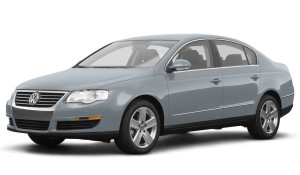 VW Passat B6 Service & Repair Manual

